Custom Furniture vs Store-Bought: What Milwaukee Woodworkers Do Better (And Why It Matters)
What's the difference between custom furniture and store bought in Milwaukee?

Written by
Trey Thorne, Goldthorne Studio
Custom Furniture Maker, Woodworking Teacher, Owner, Milwaukee
Custom Furniture vs Store-Bought: What Milwaukee Woodworkers Do Better (And Why It Matters)
If you’ve been searching for custom furniture near me in Milwaukee, you’re probably weighing a familiar question:
Should I buy something quick and affordable—or invest in something custom that’s built to last?
There’s no one-size-fits-all answer. But once you understand the real differences between store-bought furniture and working with a local craftsman, the decision becomes much clearer.
This guide breaks it down honestly; no fluff, no pressure—so you can decide what’s right for your home.
What “Custom Furniture” Really Means
Custom furniture isn’t just about picking a stain color or swapping out hardware. It means your piece is built specifically for you from the ground up. We work the gamut of custom furniture: sometimes that's altering existing designs in some fashion, and others that's building something the world's never seen before! For many cases, though, it really is more built-to-order than fully custom.
When you work with a custom woodworker in Milwaukee, you’re choosing:
- Exact dimensions that fit your space
- Your preferred wood (walnut, oak, maple, etc.)
- A finish that matches your home
- Design details that reflect your style
Exact Dimensions
Many homes in Milwaukee, especially in historic neighborhoods, are older. And those older homes were built when life was lived differently. As such, modern designs can be a pain to fit, and you're often left choosing something that "fits" dimensionally rather than the piece you wanted, but was designed for a home of modern construction. This is where custom woodworkers come in. We can take those designs, and build them for your space, and with high quality construction and materials.
Your preferred wood
I feel like everyone I know has a favorite wood. Even those of us who don't care about woodworking, or the craft. There's just something about the material that is so ubiquitous that we can't help but have opinions. And so maybe you saw an amazing table design, but hate the look of the wood used. Or you really want that walnut dining table. This is where custom furniture makers come in. We make those designs happen, locally.
A finish that matches your home
Maybe your home has unique or specific qualities that you love, but off-the-shelf furniture doesn't quite match. We can match those rich, aged surfaces. We can custom cut trim on the table, or echo shapes and details from elsewhere in your home. Simply put, we can help you build furniture that feels like it belongs in your home.
Design Details that match your style
Conversely, maybe you love your style, and you want furniture that reflects your tastes. Simply put, custom is the way to go here. Big box stores only manufacture designs that sell at a large volume. So if your style is niche, you won't find it elsewhere. This is why custom furniture makers love what we do. I love building furniture that simply doesn't exist anywhere else. I love the ability to say "no one else has this!"
Instead of adapting your home to fit furniture, your furniture is built to fit your home.
That’s a big shift from store-bought pieces, which are designed for mass appeal—not your specific space or needs.
Quality Comparison: Solid Wood vs Mass Production
One of the biggest differences comes down to materials, and it’s something most people don’t realize until years later. When my friends and I were coming of age to buy our first houses, we started filling the space with furniture. Not everyone was a woodworker, and couldn't always afford custom pieces so they opted for store bought pieces that looked nice, but bit them in the end.
I'll never forget the time I was at a good friend's house and they had just gotten a new dining table, chairs, and bench set from a furniture store. While this table looked nice, it became evident that the quality was lacking. While we were there visiting, they pointed out some places where the table's vaneer was damaged. They had only just received the table a week earlier. During that same visit, my friend sat on the bench a little too hard, and it broke.
In a week's time they'd spent nearly $2000 on a dining room set, for it to break, and show damage. While this isn't to say solid wood dining tables never break; they certainly do. The difference is twofold: damages are reparable in solid wood, and if you bought from us at Goldthorne Studio, and your table broke in the first week, we would absolutely replace it. We stand by our work. I build my furniture to be rock solid, beat up by regular living, and still be there.
Solid Wood vs Veneer: What You’re Really Paying For
Most store-bought furniture uses vaneered particle board, or MDF, and screws for their furniture builds. While these construction techniques do result in an affordable piece of furniture or table, they come with trade offs.
Vaneer
Vaneering is a woodworking technique that dates as far back as Ancient Egypt. The process involves laminating a thin slice of wood (sometimes as thin as 1/40th of an inch) over core materials, generally wood, but more commonly wood products, such as particle board and MDF. Vaneering has gotten a really bad rap in the last few decades. However, some exceptional work uses vaneering to achieve stellar results, one example being surviving furniture from the Federal Period (1780 - 1820).
There are various drawbacks to modern, off-the-shelf furniture made with vaneers. While the cost is generally substantially lower, due to cheap core materials, the quality suffers. For example, from the story above, my friend's table was an oak vaneer over MDF. Medium Density Fiberboard (MDF) is essentially compacted, glued saw dust. It's still wood, but because of the way it's engineered, it does not handle moisture well at all. As such, a table built of vaneered MDF, or particle board (which has similar characteristics) won't stand up well to repeated use. Once that vaneer is pierced, dented, or the MDF is exposed in any way, the risk of moisture getting into the material and causing irreparable damage is high, especially for a dining room table, which sees a lot of moisture, i.e. spills. Especially if you have little ones, or gand-little ones that join you for family meals.
So vaneering isn't to blame for the low quality of store bought furniture, in and of itself. The primary cause for concern is the use of the technique with low quality materials in an effort to drive down prices.
Vaneers also come with drawbacks for repairs. Because the material can be extremely thin, refinishing the surface is off the table - pun intended. Refinishing a table is a great way to freshen it up, or alter the style and look without getting a new table. If your table is vaneered with supremely thin materials, you can't do this as you'd remove the vaneer to get past the finish.
High quality vaneering is still used today, most notably in solid wood door construction. But the vaneers are significantly thicker. In door construction specifically, vaneering is used primarily to help create a stable structure. Nonetheless, this technique can be used to craft exquisite, luxury furniture. Unfortunately, big box stores just miss the mark and use it exclusively for cost-cutting measures.
MDF and Particle Board
MDF and Particle Board are two different types of engineered wood products. Both products are created from wood parts, but are not solid wood. MDF, or Medium Density Fiberboard, is somewhat what it sounds like. It's made by breaking down hard and softwoods into fibers, and compressing them with waxes and resins under pressure.
Particle board is made using wood chips and a syntheic binder, generally formaldehyde based.
Many big box stores will use these materials and similar, engineered wood products to provide low cost furniture. These do come with trade-offs. As I alluded to in the section above, neither of these materials handle moisture well. For use in a dining table, this is a major drawback, as the risk of spills coupled with usual wear is a recipe for a table that eventually falls apart. As such, we at Goldthorne Studio stay away from these engineered products in our dining room tables. We build them from solid, hardwoods. While water can be deleterious for solid lumber, properly-finished, solid hardwood tables can last decades or even centuries, if properly cared for. And proper care for a dining table is as simple as wiping spills, avoiding standing water, and regular cleanings. Merely being exposed to moisture doesn't risk our solid wood tables becoming unusable.
Staples, Nails and Screws
Large-scale, manufactured or store-bought furniture is often constructed with staples and screws. Metal fasteners are fine for many construction products, but high quality, custom, solid wood furniture generally eschews these techniques for better, time-tested joinery techniques.
Due in large part that wood moves, or it expands and contracts with the changes in moisture in the air or seasons, and metal does not, screws and nails eventually loosen. If you've ever wondered why you have to crawl underneath your old table and tighten that bolt every couple months, that's why. Wood will expand or contract, and the metal stays put, so it slowly wiggles loose.
At Goldthorne Studio, we use tried-and-true methods of constructing tables. Generally we use mortise and tenons for tables. This joinery technique has been used for millenia; it's used in projects from timber framing, to delicate boxes. This joins two pieces of wood together without metal fasteners, so they move as one piece. They never loosen, and can stay together for decades, and more likely centuries. So, if you're tired of tightening your wobbly table leg, maybe it's time to reach out, and let's get you a table that never requires that again.
Summary of the Quality Comparison
In general custom furniture is higher quality due to materials and construction technique. We at Goldthorne Studio use locally-sourced hardwoods, time-tested construction techniques, and a decade of woodworking knowledge to craft our furniture. We obsess over the details, we stand on our craftsmanship, and we're willing to back it up. That matters because:
- A solid wood dining table can last decades (or generations)
- Thinly veneered furniture often chips, peels, or warps over time
- Solid wood can be refinished and repaired
- Lower-cost materials usually can’t
The same goes for pieces like a solid wood coffee table or a real wood dining table. They age differently. They feel different. And over time, they perform very differently.
Good craftsmanship also includes stronger joinery—like mortise and tenon or dovetail joints—which adds structural integrity you simply won’t find in most big-box furniture.
Design Freedom You Can’t Get in Stores
Store-bought furniture is built around standard sizes and trends. If a piece doesn't have mass appeal, you likely won't see it at the big box stores. Whereas, if you have unique tastes, or a specific style you want to meet, custom may be the only way to go.
Maybe your dining area is just slightly too narrow. This is extremely common in Milwaukee, where older homes were built for life that was simply lived differently. As such, a lot of modern furniture just doesn't fit these older, smaller spaces. One thing we do a lot of at Goldthorne Studio, is customize designs for smaller spaces, and older homes.
Maybe you need seating for six, but don’t want a bulky table. Custom dining tables can be built with leafs so that they can be extended for large gatherings, and quickly returned to a smaller size for just your family.
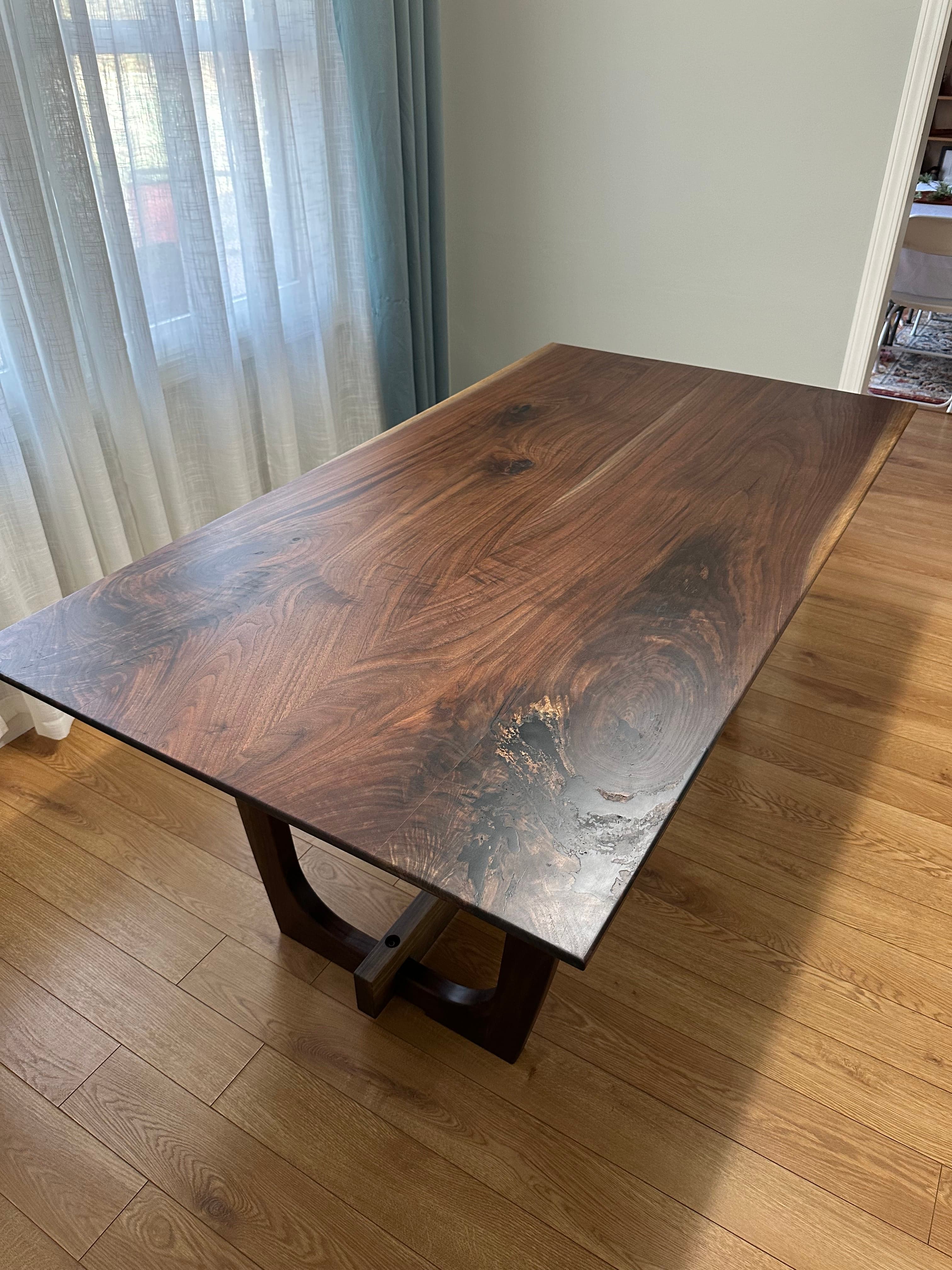
Maybe you’ve been searching for a walnut dining table and can’t find the right tone or shape anywhere. Walnut dining room tables are all the rage. We get it. They're lovely, classic, and durable tables. Walnut is generally a pricier wood because Walnut trees are very slow growing. So large furniture manufacturers who are trying to compete on price shy away. However, we love building tables and furniture from walnut!
This is where custom really shines.
With custom woodworking, you can:
- Adjust dimensions down to the inch
- Choose between round, rectangular, or oval designs, or really anything you dream up
- Create features like extensions or custom bases
- Match existing finishes in your home
Instead of compromising, you get something that fits your space, and your style, exactly.
Longevity & Cost Over Time
At first glance, store-bought furniture usually wins on price. But over time, the equation changes.
Let’s look at a simple example:
- A $900 dining table replaced every 7–10 years
- A $2,500 custom solid wood table that lasts 25–30+ years
Over time, the custom piece often ends up costing the same—or less.
But cost isn’t just about money. It’s also about:
- The hassle of replacing furniture
- Inconsistent quality
- Pieces that never quite feel right in your space
Custom furniture is an investment—but it’s one that pays off in durability, function, and everyday satisfaction.
Why Working with Local Furniture Makers in Milwaukee Matters
There’s also something to be said for keeping things local.
When you work with a Milwaukee woodworker, you’re not just placing an order, you’re starting a conversation.
Here’s what that looks like in practice:
- You can talk through ideas and get real input
- You can see wood samples in person
- You get updates during the process
- Delivery and fit are handled with care
And just as importantly, you’re supporting local craftsmanship—people who take pride in what they build and stand behind their work.
Another story that comes to mind is a table I was designing for a client. They came with a couple ideas, and requirements. The table needed to be able to comfortably seat folks at the heads of the table. We ideated through a few designs, but I wanted to be sure that the designs met the requirements. I designed multiple models based on designs we worked through, and was able to spec out exactly where standard chairs would fit at the heads of the table, and where folks on the side would be seated, and even down to how well the chairs would sit under the table when not in use (which if you've ever stubbed a toe on a chair that was sticking out too far, you know why this is important). We finally settled on a more classic design, but it was definitely unique. I wrote about this process a bit in my post about working with a custom woodworker.
If you’ve ever searched for furniture makers near me or local furniture makers, this is the difference you’re really looking for: connection, accountability, and quality you can trust. We take the process seriously. We do as much design and consulting work up front as possible to ensure that when our tools meet the wood, we're working towards exactly what you want and need to fill your space.
When Store-Bought Furniture Does Make Sense
To be fair, custom isn’t always the right choice.
Store-bought furniture can be a great option if:
- You need something quickly
- You’re furnishing a temporary space
- You’re working within a tight budget
There’s nothing wrong with choosing convenience when it fits your situation.
When You Should Choose Custom Furniture
Custom furniture tends to be the better choice when:
- You want a solid wood dining table that will last for decades
- Your space has specific size or layout needs
- You’re tired of replacing furniture every few years
- You want a statement piece (like a walnut dining table)
- You value craftsmanship and materials
In these cases, custom isn’t just a luxury—it’s a smarter long-term decision.
Frequently Asked Questions
Is custom furniture worth the price?
For many homeowners, yes. While the upfront cost is higher, the longevity, quality, and fit often make it a better value over time.
How long does custom furniture last?
A well-built solid wood piece can last decades. Some high quality pieces have last even longer, on the order of centuries
Is solid wood better than engineered wood?
Solid wood is generally more durable, longer-lasting, and repairable. Engineered wood can be useful in certain applications, but it doesn’t offer the same lifespan. In most cases, engineered wood isn't the right choice for furniture, outside of high quality plywood.
How do I find a good custom woodworker near me?
Look for:
- Examples of past work
- Clear communication
- Transparency around materials and process
- Local reviews or referrals
How much does a custom dining table cost?
Costs vary based on size, wood type, and design, but most custom dining tables fall somewhere between $2,000–$5,000. Smaller pieces are usually cheaper, but prices vary dramatically because the products vary dramatically.
Final Thoughts
Choosing between custom and store-bought furniture isn’t just about price; it’s about how you want your home to feel and function over time.
If you’re looking for something that fits your space perfectly, holds up for years, and reflects your style, custom furniture is hard to beat.
And if you’re in the Milwaukee area, working with a local craftsman means you don’t have to figure it out alone. You can always reach out. We're happy to talk about your needs and designs, and see if we're a good fit for what you're looking to do! I love to talk about furniture, wood, and furniture construction techniques, so we're always happy to field questions!